
Extend the Life of Your Suspension: Why Regular Greasing of U-Joints and Ball Joints Matters
- Alan
- Jan 8
- 3 min read
Suspension components like U-joints and ball joints often go unnoticed until they fail. Many vehicle owners overlook a simple maintenance step that can save hundreds or even thousands of dollars: regular greasing. Neglecting to grease these parts causes them to wear out faster, leading to costly repairs and a rougher ride. This post explains why greasing your suspension is essential, where to find these components, and how this small task can extend the life of your vehicle’s suspension system.

What Are U-Joints and Ball Joints?
Understanding what U-joints and ball joints do helps explain why they need regular greasing.
Ball joints connect the control arms to the steering knuckles. They allow the wheels to move up and down while steering left or right. Ball joints are located on both the upper and lower control arms.
U-joints (universal joints) are found on the drive shaft. They allow the drive shaft to flex and transmit power smoothly from the transmission to the wheels, even when the suspension moves.
Both parts experience constant movement and friction. Without lubrication, metal parts grind against each other, causing wear and eventual failure.
Why Greasing Suspension Parts Matters
Greasing these components is not just a routine task; it directly impacts your vehicle’s safety, performance, and repair costs.
Reduces friction and wear: Grease forms a protective layer that prevents metal-on-metal contact.
Prevents rust and corrosion: Moisture can cause rust, which weakens joints and leads to premature failure.
Improves suspension performance: Well-lubricated joints move smoothly, maintaining proper wheel alignment and handling.
Saves money: Replacing worn ball joints or U-joints can cost hundreds of dollars. Regular greasing can delay or prevent these repairs.
Ignoring this maintenance can lead to symptoms like clunking noises, uneven tire wear, and poor steering response.
How to Locate and Grease Ball Joints
Ball joints are located on the upper and lower control arms of your vehicle’s suspension. Here’s how to find and grease them:
Locate the control arms: Look under your vehicle near the wheels. The control arms connect the wheel hub to the frame.
Identify the ball joints: They appear as round, pivoting joints at the ends of the control arms.
Check for grease fittings: Many ball joints have a small grease fitting (zerk fitting) where you can attach a grease gun.
Apply grease: Use a grease gun filled with the recommended type of grease (usually lithium-based). Pump grease until you see old grease or dirt pushed out.
Wipe excess grease: Clean off any spilled grease to prevent dirt buildup.
If your ball joints don’t have grease fittings, they may be sealed and require replacement when worn.
How to Locate and Grease U-Joints
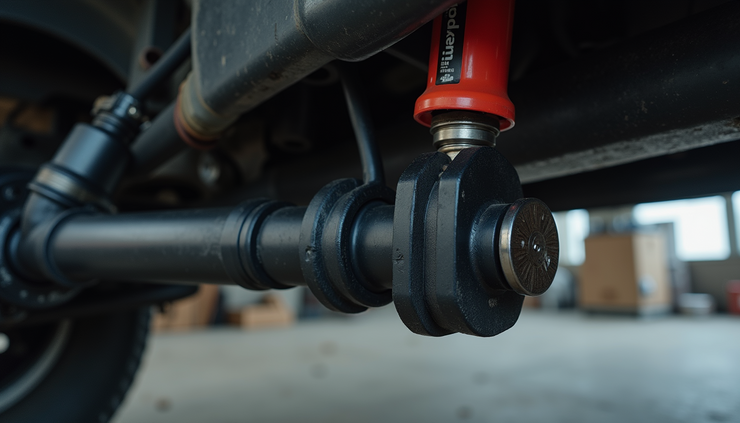
U-joints are found on the drive shaft, usually between the transmission and the rear differential (or front differential on some vehicles).
Find the drive shaft: It’s a long metal shaft running underneath the vehicle.
Locate the U-joints: They are at the ends of the drive shaft, connecting it to other drivetrain components.
Look for grease fittings: Most U-joints have grease fittings.
Use a grease gun: Apply grease until you see old grease or dirt pushed out.
Check for wear: While greasing, inspect for rust, looseness, or damage.
Regular greasing of U-joints prevents vibration, noise, and eventual drive shaft failure.
How Often Should You Grease Suspension Components?
The frequency depends on your vehicle type, driving conditions, and manufacturer recommendations.
General rule: Grease suspension parts every 5,000 to 10,000 miles.
Severe conditions: If you drive on dirt roads, through mud, or in wet climates, grease more often.
Check your owner’s manual: Follow specific guidelines for your vehicle.
Regular inspections during oil changes or tire rotations are a good time to grease these parts.
Signs You Need to Grease or Replace Suspension Joints
Ignoring greasing can lead to noticeable problems. Watch for these signs:
Clunking or knocking noises when driving over bumps or turning.
Vibration or shuddering in the steering wheel.
Uneven tire wear or rapid tire damage.
Loose or wandering steering.
Visible rust or damage on joints.
If you notice these symptoms, inspect the joints immediately. Greasing may fix minor issues, but worn parts will need replacement.

Tips for Effective Suspension Maintenance
Use the right type of grease recommended by your vehicle manufacturer.
Clean grease fittings before applying grease to avoid contamination.
Avoid over-greasing, which can damage seals.
Inspect suspension components regularly for wear or damage.
If unsure, have a professional mechanic check your suspension.


Comments